Much of experimental physics asks what we can learn about a physical system from a given measurement. We take a broader, complementary view: how is information about a physical system represented in light, how is it transformed, what is fundamentally accessible, and what measurements are required to access it?
Our lab studies the physical structure and flow of information in optical and photonic systems: where information resides in optical degrees of freedom, how it is reshaped by wave and quantum dynamics, and the fundamental limits, physical resources, and measurement complexity governing how it can be extracted.
Our research program is organized around these questions rather than around a particular platform or technique. Across metasurfaces, programmable optics, integrated photonics, and structured quantum light, we combine theory, computation, and experiment to uncover general principles and realize them in physical systems.
Information-driven photonics for sensing and imaging
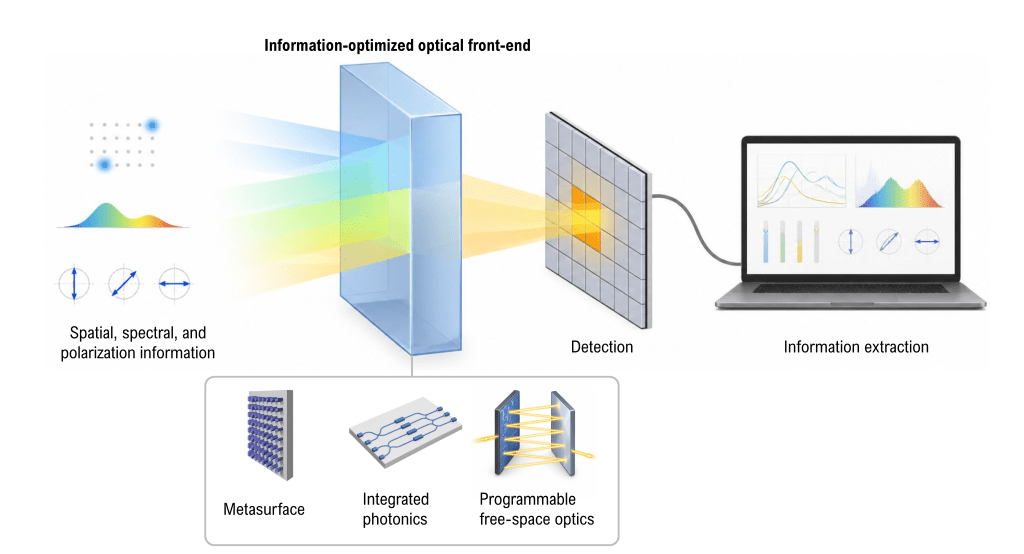
We study how optical fields can be transformed to improve the estimation of physical parameters in sensing and imaging tasks. In particular, we investigate how spatial, spectral, and polarization degrees of freedom can be controlled to match the underlying physics of the measurement problem. This work is closely connected to areas such as computational imaging, while emphasizing physically grounded approaches to measurement design and information extraction.
Our work employs a range of photonic platforms, including optical metasurfaces, photonic integrated circuits, and programmable free-space optics. We develop these systems using a combination of analytical models and computational approaches, including inverse design and optimization, to realize optical transformations that efficiently extract relevant information from light. Applications include hyperspectral and thermal imaging, as well as parameter estimation under realistic constraints.
Selected recent work:
- Fisher-information training of optical sensing front ends from natural fluctuations [arXiv:2609.24915]
Enabling in-situ adaptation of optical sensing front ends without a calibrated response model or parameter-labeled data.
Structured quantum light for quantum metrology and simulation
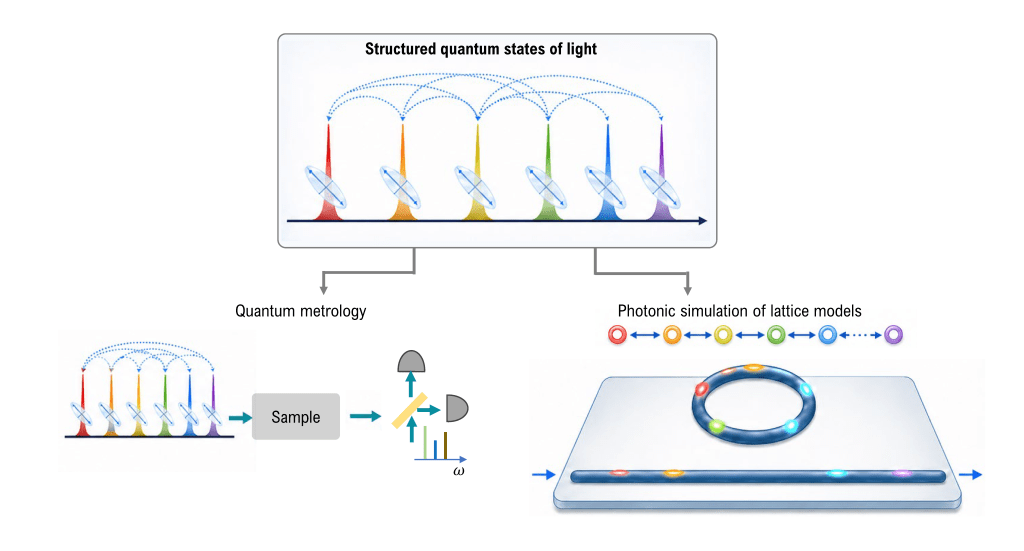
We study structured quantum states of light as resources for quantum metrology and photonic simulation. A major focus is on continuous-variable quantum optics, where squeezing, quantum correlations, and multimode field structures provide a natural language for studying both precision measurement and bosonic dynamics.
For metrology, we develop theoretical and experimental tools to understand how physical information is encoded in quantum optical fields and how it can be accessed under realistic constraints such as loss and finite detection efficiency. For quantum simulation, we explore how the frequency modes of light can be used as synthetic dimensions to realize programmable bosonic lattice models, including topological and non-Hermitian photonic systems.
Selected recent work:
- Critical quantum metrology in the output of an optical parametric oscillator [arXiv:2609.15974]
Connecting critical enhancement inside an open quantum sensor to information accessible in its measurable output.
Other exploratory directions
We also pursue exploratory projects in related areas of optical physics and photonics, often motivated by tools and questions arising from our main research directions. Current topics include programmable photonic systems for computing and simulation, non-Hermitian dynamics, topological photonics, quantum communication concepts, and related studies of light–matter interaction.

